
Xenon Lamp Aging vs. UV Aging: Which Is Better for Your Product?
发布时间:2026-06-25 分类:News、Technical Articles 浏览量:5
In the field of material weathering testing, manufacturers often face a critical decision: Should we invest in a Xenon Arc test chamber or a Fluorescent UV aging chamber?
Choosing the wrong testing equipment not only means a wasted investment but could also lead to massive product recalls if the test results don't reflect real-world durability. This guide breaks down the differences in spectra, failure modes, and selection logic to help you decide.
1. Xenon Arc Testing: Full-Spectrum Sunlight Simulation
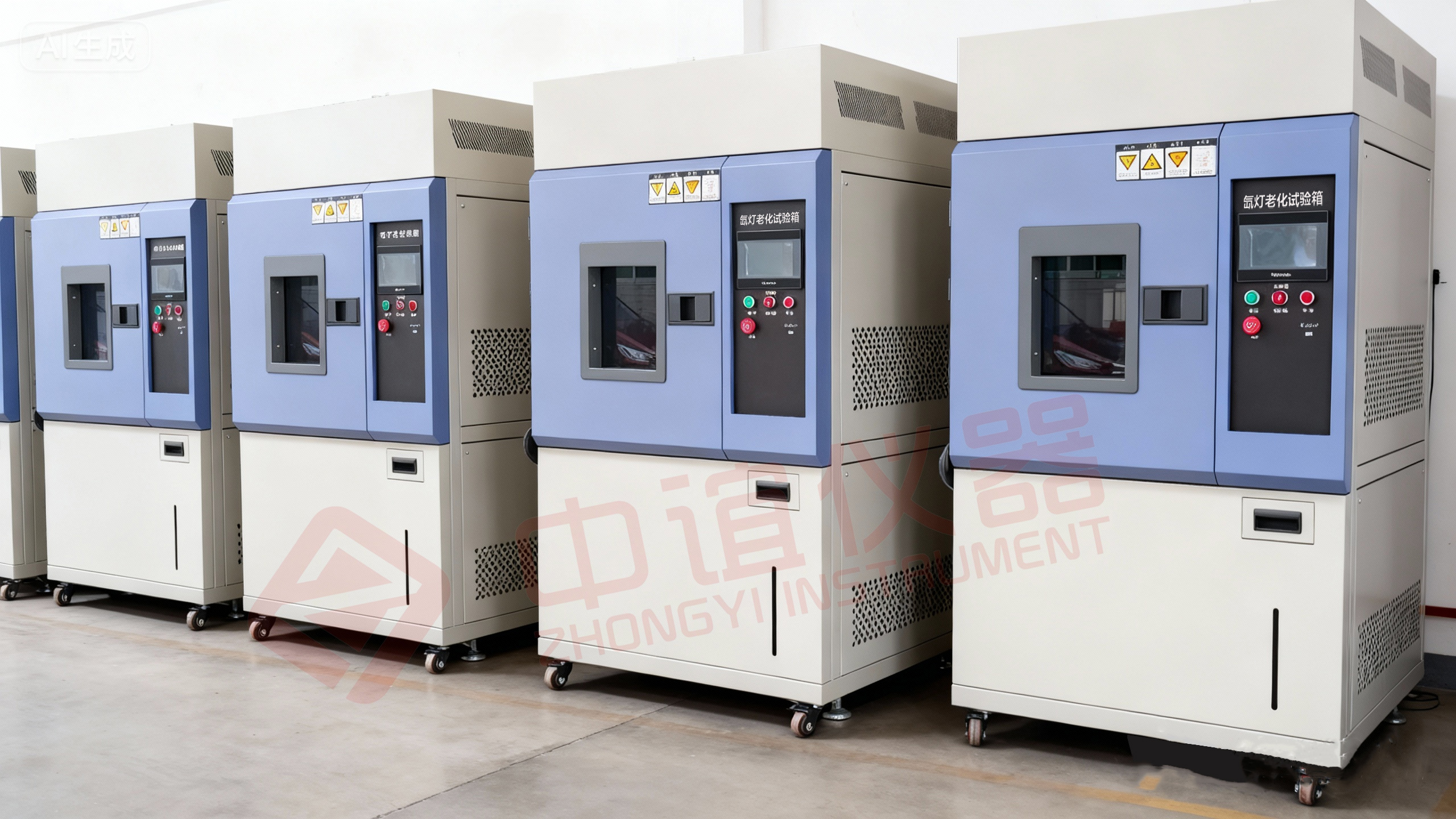
Xenon arc chambers use Xenon Arc Lamps to reproduce the full spectrum of sunlight, including UV, visible light, and infrared (IR). By using different filters (e.g., Daylight or Window Glass filters), it provides the most realistic simulation of actual outdoor or indoor exposure.
- Best For: Predicting color change, fading, and gloss loss.
- Key Advantage: Accurate simulation of thermal effects (Heat) due to the IR wavelength.
- Top Industries: Automotive interiors, textiles, high-end coatings, and consumer electronics.
- Standards: ISO 4892-2, ASTM G155, SAE J2527.
2. UV Aging Testing: Accelerated Photo-Chemical Degradation
UV testers (like the QUv) focus on the short-wave UV radiation (280nm to 400nm), which is the most damaging part of sunlight for polymers. It doesn't try to replicate full sunlight but concentrates the "killing power" of UV to accelerate results.
- Best For: Predicting physical degradation such as cracking, chalking, embrittlement, and loss of tensile strength.
- Key Advantage: Superior simulation of outdoor moisture via the Condensation mechanism, which is often more destructive than rain in real environments.
- Top Industries: Plastics, roofing materials, solar backsheets, adhesives, and sealants.
- Standards: ISO 4892-3, ASTM G154, GB/T 16422.3.
3. Comparison at a Glance
| Feature | Xenon Arc Chamber | Fluorescent UV Chamber |
|---|---|---|
| Light Source | Xenon Arc (Full Spectrum) | Fluorescent UV (Short-wave) |
| Wavelength Range | 290nm – 800nm+ | 280nm – 400nm |
| Primary Degradation | Fading, Discoloration, Heat damage | Cracking, Chalking, Embrittlement |
| Moisture System | Water Spray | Condensation + Water Spray |
| Maintenance Cost | High (Lamps & Filters) | Low (Cost-effective lamps) |
4. Decision Matrix: Which One Do You Need?
Step 1: Identify the Primary Failure Mode
- Are you worried about Aesthetics (Fading/Color shift)? → Choose Xenon Arc.
- Are you worried about Structural Integrity (Cracking/Breaking)? → Choose UV Testing.
Step 2: Consider the Environment
- Indoor/Window exposure (e.g., curtains, indoor plastics) → Xenon Arc (with window glass filter).
- Harsh Outdoor/Dew-heavy exposure (e.g., roof rolls, outdoor pipes) → UV Aging (leveraging its condensation cycle).
Step 3: Budget and Throughput
- If your industry standards (like GM or VW) mandate full-spectrum testing → Xenon is mandatory.
- If you need a high-volume, cost-effective screening tool for formula development → UV Aging is the perfect ROI choice.
In modern quality control, these two methods are complementary. Many global labs use UV chambers for fast screening of polymer formulations and then validate the final product’s color stability in a Xenon chamber.

 豫公网安备41032502000206号