


Application:
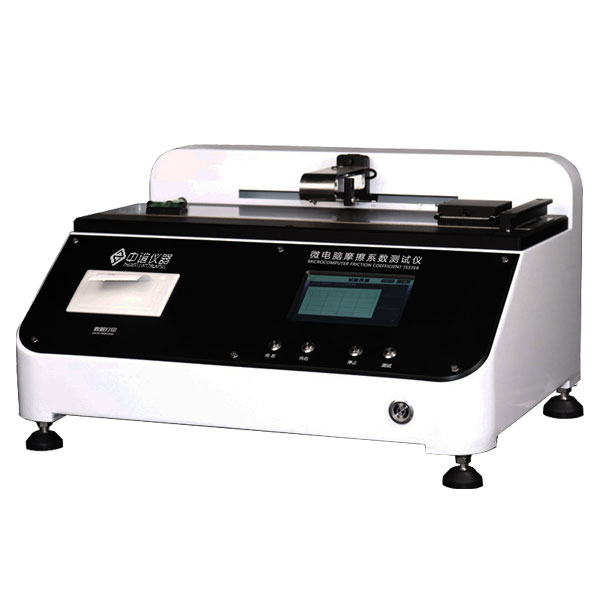
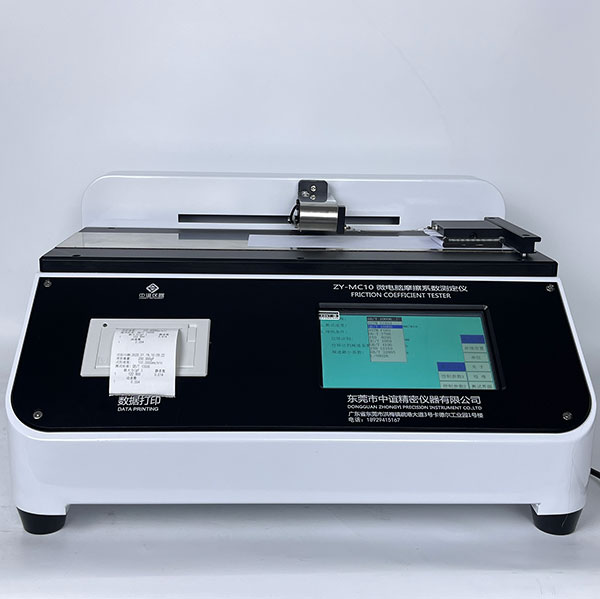
The ZY-MC10 Coefficient of Friction Tester is specifically designed to measure the static and dynamic friction coefficients of materials such as plastic films and sheets, rubber, paper, cardboard, woven bags, fabrics, composite metal tapes for telecommunications and optical cables, conveyor belts, wood, coatings, windshield wipers, footwear materials, and tires during sliding. By measuring the slipperiness of materials, manufacturers can control and adjust production quality and process parameters to meet product performance requirements. Additionally, it can be used to determine the slip properties of daily chemical products such as cosmetics and eye drops.
Manufactured in accordance with the national standard GB/T 10006, “Plastics—Films and Sheets—Determination of Coefficient of Friction,” this is the ideal testing equipment for quality inspection departments at all levels and manufacturing enterprises, providing you with accurate test results.
Complies with various standards, including GB/T 17200, GB/T 22895, ISO 8295, ASTM D1894, TAPPI T816, GB/T 2792, and others
Principle of Operation:
A strip-shaped test specimen is clamped in a specimen holder, and the specimen is wrapped around a slider. The slider is then mounted in the sensor’s mounting hole. Under a specified contact pressure, a motor drives a rack to move the sensor, causing the two test surfaces to move relative to each other. The force signal measured by the sensor is amplified by an integrator and sent to a recorder, which simultaneously records the coefficient of kinetic friction and the coefficient of static friction.
Key Performance Advantages:
- Equipped with a stepper motor for low noise and precise control
- Features a large-screen color touchscreen LCD display that shows real-time data
- Simple parameter setup and convenient, reliable testing
- Provides immediate measurement results, including average values and standard deviation
- High degree of automation: Capable of data processing and motion control, with automatic reset and overload protection
- Data Communication: The instrument is equipped with a standard WAN interface to provide data communication for upper-level computer-based reporting systems
- Capable of simultaneously measuring dynamic and static friction coefficients; test speed is programmable and adjustable, supporting any slider mass;
- Built-in overload protection device; automatically returns to home position after testing is complete;
- Capable of statistical analysis and processing of test results in batches;
- Built-in modular thermal printer for direct printing of test reports;
Scope of Application for the Coefficient of Friction Tester:
- Films: Suitable for testing the static and dynamic coefficients of friction of plastic films and sheets
- Paper: Suitable for testing the dynamic and static coefficients of friction of paper and cardboard
- Textiles, non-woven fabrics, and woven bags: Suitable for testing the static and dynamic coefficients of friction of textiles, non-woven fabrics, and woven bags
- Rubber: Suitable for testing the static and dynamic coefficients of friction of rubber
- Aluminum foil, aluminum foil composite films, and metal products: Suitable for testing the static and dynamic coefficients of friction of aluminum foil, aluminum foil composite films, and metal products
- Printed materials: Suitable for testing the static and dynamic coefficients of friction of printed materials
- Wood and flooring materials: Suitable for testing the static and dynamic coefficients of friction of wood and flooring materials
- Film: Suitable for testing the static and dynamic coefficients of friction of film
- Grains: Suitable for testing the static and dynamic coefficients of friction between grain particles and materials such as metal
- Hair: Suitable for testing the static and dynamic coefficients of friction between strands of hair
- Enameled Wire: Suitable for testing the static and dynamic coefficients of friction between enameled wire and other flat materials

 豫公网安备41032502000206号